Case study

Turning Retainer Data into Commercial Insight

At a glance

Tangram designed a client-facing retainer dashboard that gives an up-to-date view of retained work, forecast utilisation and overall account performance.

The Challenge

One of dentsu Creative Australia‘s largest client requires viability of effort on multiple business units through a complex retainer arrangement. Although teams could see the work being delivered, they could not easily determine how much of each retainer had been consumed or how retained resources were being used across individual deliverables. Timesheets were historically recorded against central retainer projects, making it difficult to connect resource usage with the jobs where the work was actually performed. 

The client wanted a single, reliable view that separated retained and non-retained activity. This needed to show how much retained resource had been used on each job, alongside any out-of-scope work that could result in additional charges. 

The complexity increased because the same role could be treated as retained or non-retained depending on the job, deliverable and agreed scope. The solution therefore needed to classify time accurately without relying on ongoing manual intervention. 

Both the agency and client also wanted project estimates and statements of work to clearly show the value of retained and non-retained resources on each job. 

Existing reporting relied heavily on spreadsheets and manual investigation. This made it difficult to monitor account performance, identify out-of-scope work and forecast when retained capacity might be exceeded. 

dentsu Creative Australia needed a Microsoft Power BI dashboard using data from its agency RPM and finance system, to support internal management and forecasting of retainer hours, as well as client reconciliation reporting.  

Tangram took what had become a complex, manual reporting process and turned it into something our teams and our client could genuinely rely on. For the first time, we had a real-time view of retainer performance, giving us greater confidence in the conversations we were having with our client. It has strengthened transparency, improved how we manage the account, and given us a much better foundation for planning ahead.

Vanessa Nicol
Chief Operating Officer

The Solution

Tangram began by redesigning how retained work was identified and managed within their ERP. 

A structured business process and supporting data architecture were established to identify and separate retained activity from out-of-scope work at the point of entry. The solution applied the required business-unit, job, activity and resource logic automatically, while preserving dentsu’s established ways of working wherever possible. 

This allowed retained and non-retained resources to be recorded against the same job and automatically reflected in project estimates and statements of work, removing the need for teams to calculate or reconcile the split manually. 

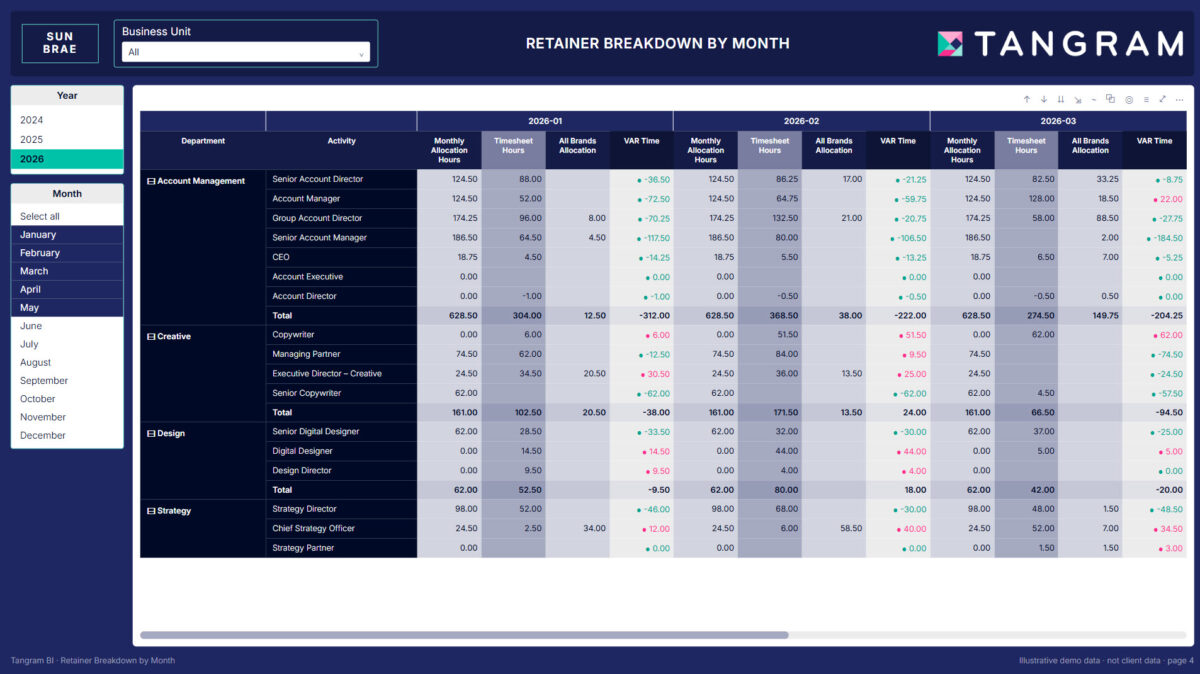
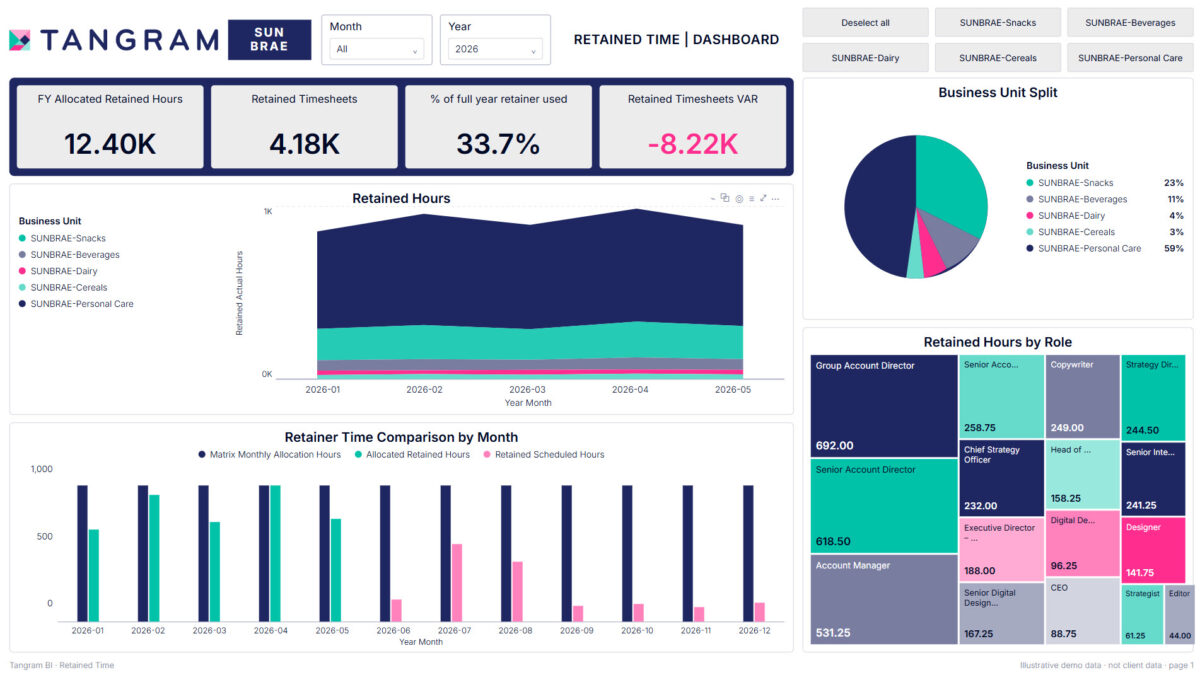
Once the underlying data architecture was established, Tangram designed and delivered a client-facing Business Intelligence dashboard combining: 

  • Retainer consumption by business unit 
  • Live project and timesheet activity 
  • Forecast retained workload 
  • Remaining retainer balance 
  • Retained and non-retained activity by job 
  • Forward-looking utilisation and capacity projections 

The solution was delivered entirely within dentsu’s existing technology environment. It required no additional reporting platform or external database and was designed to scale across other clients operating under retained commercial models. 
The Results

  • Clear, up-to-date visibility of retainer usage for both dentsu and the client 
  • Retained and non-retained activity automatically identified at job level 
  • Manual spreadsheet reporting and investigation replaced with automated reporting 
  • Approximately 10 hours of reporting effort saved each month 
  • Earlier identification of potential out-of-scope work 
  • Forward forecasting of retained capacity, helping teams act before over-servicing occurs 
  • A scalable commercial reporting framework that can be rolled out across additional retained clients 

Better reporting starts with capturing useful data without overcomplicating how people work. Connecting time, project and schedule data puts performance insights at management’s fingertips, saving time, removing the need for manual reports and enabling earlier, better-informed decisions. Sharing that clear, consistent view with clients keeps everyone on the same page about progress, priorities and performance.

Heshan Lorenz-Daniel
Consultant at Tangram

More projects by Tangram